The World of Numbers
Class 09 MathsNatural Numbers (ℕ) are the counting numbers {1, 2, 3, ... } that emerged at least tens of thousands of years ago due to humanity’s need to count.
Concept of Zero
The Concept of Zero (Śhūnya) was formalised in India by philosophers and then brought into mathematics formally by Brahmagupta (629 CE), who transformed the philosophical state of ‘nothingness’ into an actual number on which one could perform arithmetic operations. Brahmagupta also introduced the negative numbers, i.e., numbers less than zero.
Brahmagupta's Rules for Zero
- When zero is added to a number, the number remains unchanged: a + 0 = a.
- When zero is subtracted from a number, the number remains unchanged: a – 0 = a.
- When any number is multiplied by zero, the result is zero: a × 0 = 0.
Integers
Brahmagupta did not stop at zero. He realised that if subtraction of a number from itself can result in zero (5 – 5 = 0), then what would happen if we subtracted a larger number from a smaller one (3 – 5)? To answer this, Brahmagupta grounded his mathematics in the reality of commerce and life. He recognised two states:
- Fortunes (Dhana): Positive numbers, representing wealth or assets.
- Debts (Ṛiṇa): Negative numbers, representing debts.
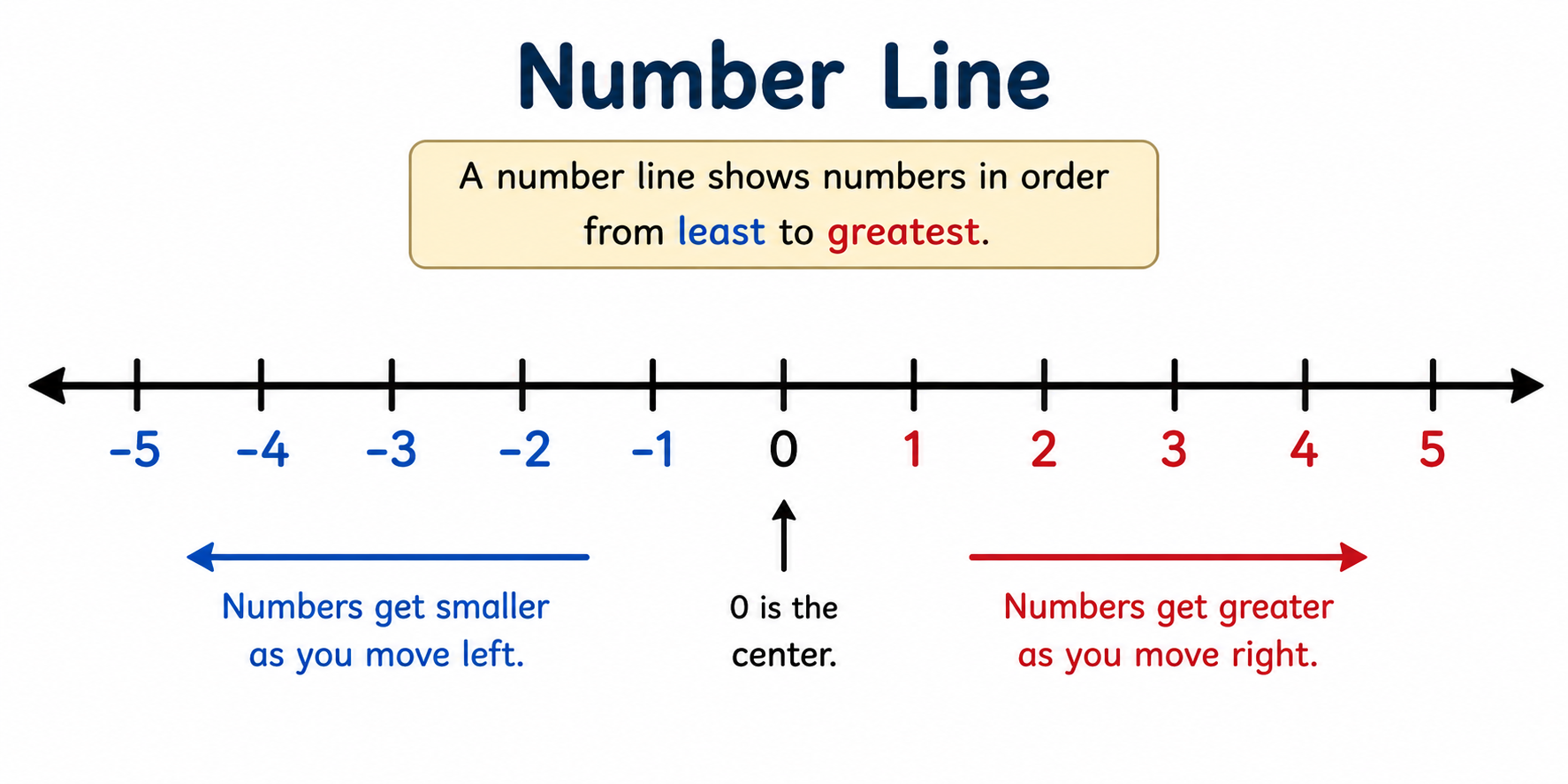
By moving to the left of zero on the number line, Brahmagupta formally introduced Negative Numbers. The combination of positive natural numbers, their negative counterparts, and zero creates the set of Integers, denoted by the symbol ℤ.
Integers (ℤ) extend the number line to the left of 1 to include zero as well as the negative numbers, which Brahmagupta historically categorised as ‘debts’ (ṛiṇa) in contrast with the positive number ‘fortunes’ (dhana).
Arithmetic of Integers
Brahmagupta gave explicit rules for adding and multiplying integers.
1. A fortune plus a fortune is a fortune: 5 + 4 = 9.
2. A debt plus a debt is a debt: (–5) + (–4) = –9. (If you owe ₹5 and borrow ₹4 more, you owe ₹9.)
3. A fortune minus zero is a fortune, a debt minus zero is a debt: 7 – 0 = 7, and – 6 – 0 = –6.
4. The product of a debt and a fortune is a debt: (–3) × 4 = –12. (If you take on 4 debts of ₹3, your total debt is ₹12.)
5. The product of two debts is a fortune: (–3) × (–4) = 12.
Rational Numbers
As society grew more complex, measuring became just as important as counting. If a farmer divides a field of wheat among his three children, how much does each get? If a recipe calls for half a cup of ghee, how do we represent that mathematically?
Numbers that represent parts of a whole are called fractions.
Rational Numbers (ℚ) are defined as any number that can be expressed as a ratio p/q (where p and q are integers and q ≠ 0). Brahmagupta also gave the formal rules for addition, subtraction, multiplication, and division of rational numbers. Rational numbers are dense, meaning a rational number always exists between any two other rational numbers.
Absolute value of a rational number
The absolute value of a rational number x, written as |x|, represents its distance from 0 on the number line.
The absolute value of a positive number is the number itself. The absolute value of a negative number is its positive value. Therefore, the absolute value of any rational number is always non-negative, that is, |x| ≥ 0.
For two rational numbers a and b, the distance between them on the number line is given by |a – b|.
Irrational Numbers
For centuries, mathematicians believed that every measurable length in the universe could be represented as a ratio of two integers. However, when Baudhāyana composed his Śhulbasūtra (a manual for constructing complex geometric fire altars) in around 800 BCE, he quickly encountered lengths that defied fractions. The ancient Greeks encountered the same crisis a few centuries later.
Consider a square where each side is exactly 1 unit long. By the Baudhāyana–Pythagoras Theorem, the length of the diagonal d is given by 12 + 12 = d2, so d2 = 2. Therefore, the length of the diagonal is √2. Numbers on the number line that cannot be expressed as a ratio of integers are called Irrational Numbers.
Irrational Numbers are values like √2 and π that cannot be written as fractions. Their existence proves that the number line contains gaps that rational ratios alone cannot fill.
Real Numbers
If you divide the numerator of a rational number by its denominator, exactly one of two things will happen:
- It terminates: The division eventually leaves a remainder of 0. The decimal stops. For example: 3/8 = 0.375.
- It repeats: The division never reaches a remainder of 0, but the sequence of digits begins to loop infinitely. For example: 5/11 = 0.454545 ...
Real Numbers (ℝ) represent the total union of all rational and irrational numbers, forming a perfectly continuous and unbroken line where every real physical measurement has a corresponding point.
Decimal expansions serve as a mathematical signature for rational vs. irrational: rational numbers always result in terminating or repeating decimals, while irrational numbers produce non-repeating decimals that continue infinitely.
Imaginary Numbers
Imaginary Numbers are introduced as a final conceptual frontier to handle operations like √−1, which cannot be solved on the real number line and require a new dimension of mathematics.